Non Selective Herbicides
Non Selective Herbicides are Intended to control or prevent all vegetation. Most are systemic; they work through foliar absorption or soil residual root uptake.

You Are Here: VegClear Home > Resources > Herbicides
Industrial weed control herbicides are EPA-labeled chemical solutions used to eliminate or suppress vegetation on non-cropland sites such as gravel yards, substations, rail corridors, fence lines, and rights-of-way. These programs rely on a combination of post-emergent and residual chemistry to control existing growth and prevent regrowth over extended periods.
Non Selective Herbicides are Intended to control or prevent all vegetation. Most are systemic; they work through foliar absorption or soil residual root uptake.

Selective Herbicides control specific types of vegetation. They are used to selectively kill or manage certain species of plants, while not harming others. Selectivity can be through application method and dilution.

Products that control existing growth after it emerges through foliar and/or soil activity to kill existing targets. It causes brownout and visible vegetation decline.

Soil active (residual) herbicide options are applied prior to plant emergence or seed germination. They act on plants before or as they germinate, preventing growth.


Effective industrial vegetation management requires more than periodic spraying. Postemergent herbicides remove existing growth, while preemergent residual chemistry prevents new germination. Combining both strategies provides long-term control, reduces labor cycles, and maintains access across industrial sites, utilities, and commercial property.
Postemergent herbicides are used for initial knockdown of existing weeds, brush, and invasive vines. Some kill foliage on contact for rapid visual results and improve site accessibility. Others systemically control growth once the herbicide is absorbed through foliage. Targeted spot treatments minimize overspray and reduce material usage compared to broad blanket applications.
For areas that require extended control, such as gravel yards, rights of way, substations, and fence lines, residual herbicides create a soil-active barrier that prevents regrowth for a full season in the Southeast. Tank mixes using active ingredients such as Glufosinate, Imazapyr, Triclopyr, and Diquat provide a multi-layer approach to both kill existing plants and stop germination.
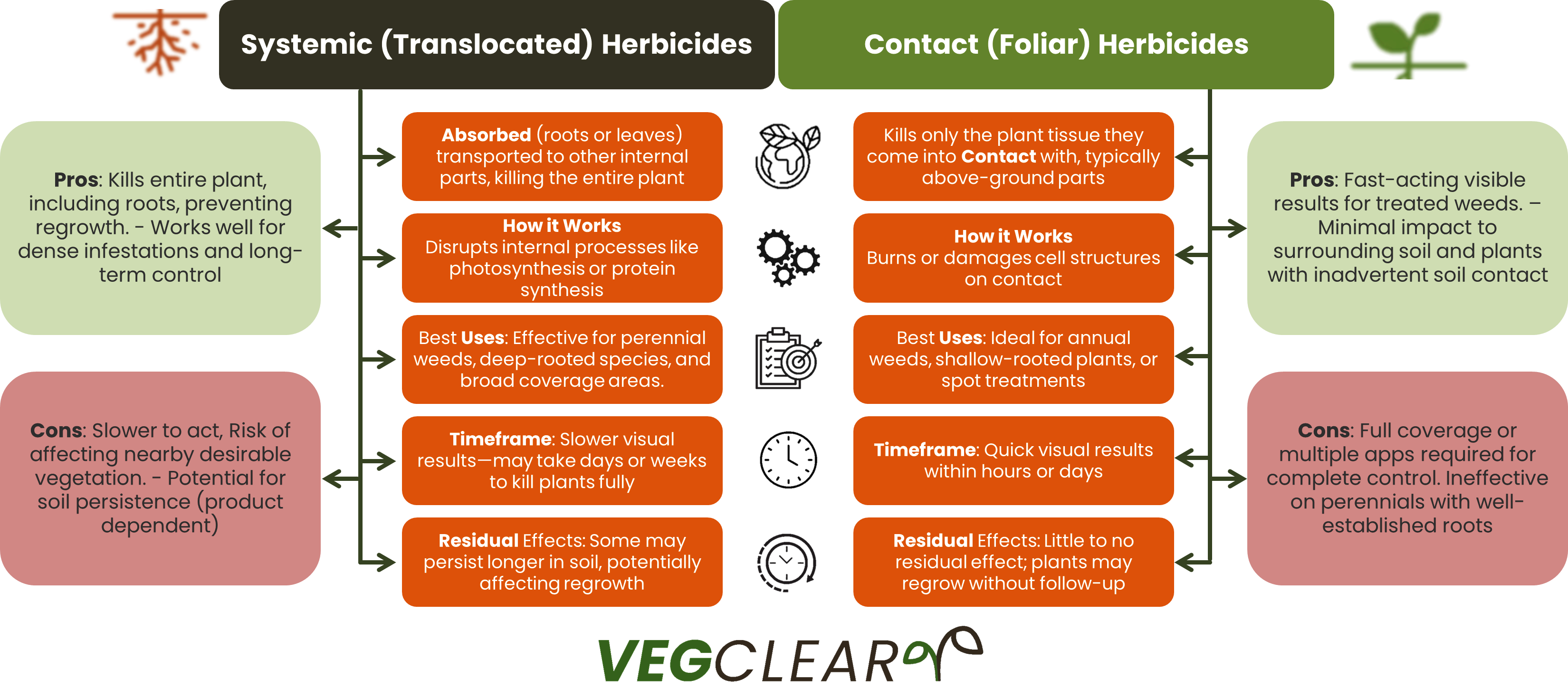
Foliar herbicides act on contact and work best for fast visual suppression. Systemic herbicides absorb into the plant and move through internal pathways to kill the entire structure. They work more slowly but provide deeper control of woody stems and perennial vines such as kudzu and muscadine. VegClear selects the appropriate chemistry based on plant type, environmental sensitivity, and performance goals.
One key additional benefit of our multi mode tank mix approach is the minimized use of chemical concentrate compared to using any one of these products alone. Based on species, site type, and treatment objective, these active ingredients are used at varying concentrations, ensuring that the goal of reduced and eliminated vegetation is achieved in the most environmentally responsible way possible.
VegClear uses only EPA-registered herbicides approved for industrial and right-of-way vegetation management. Products are designed to break down in the environment and are applied with calibrated equipment including backpack sprayers, broadcast rigs, shielded booms, and controlled droplet technologies. This protects workers, nearby vegetation, and sensitive ecosystems while reducing reliance on mechanical mowing.
Bareground herbicides create total vegetation control for areas where plants cannot exist, such as substations, industrial yards, tank farms, power generation, and roadway infrastructure. These products prevent germination for several months up to a year and help prevent access obstructions, fire hazards, and equipment interference. Long-term success depends on rotating modes of action to prevent herbicide resistance and maintain performance consistency.
VegClear Utilizes Selective & Non Selective Herbicides
Industrial vegetation management relies on USDA, EPA, and state-approved herbicides to control unwanted vegetation on commercial and industrial properties. The products listed below represent some of the most commonly used active ingredients for selective weed control and total vegetation control (TVC) where bareground is required. All herbicide selection and application is performed in accordance with EPA labels and site-specific requirements. All applicators must adhere to label restrictions. All sites are different and require individual assessment of whether a particular herbicide is suited for the treatment area.
VegClear technicians use precision tank mixes and calculated application sequencing to deliver effective control. Depending on plant type, season, and site conditions, treatments may combine multiple herbicides in a single application or apply targeted follow up treatments for improved penetration and long-term results.
Strategic use of the right chemistry, at the correct rate and timing, is essential for performance, environmental protection, and cost efficiency. To discuss herbicide selection or program design for your site, Request a site review for herbicide program design today.
The products below represent key herbicide active ingredients widely used across Georgia and the Southeast for commercial, utility, right of way, and industrial vegetation control. These chemistries support selective and non-selective applications, brush management, and total vegetation control (TVC) where bareground is required.
Selective, postemergent
Triclopyr based products are often used for Brush Killer applications. It is a post-emergent herbicide used to control thick vegetation in various areas. It is formulated with the active ingredient Triclopyr and is ideal for clearing woody plants, brush, and broadleaf weeds.
Controls woody brush, vines, and broadleaf weeds including kudzu, poison ivy, Virginia creeper, wisteria, sweetgum, and young hardwoods.
Used along rights of way, industrial yards, substations, fence lines, and naturalized buffer areas.
Effective for foliar and basal bark applications and late season treatments.
Ideal for invasive vine control where complete systemic kill is required.
Ingredients: Triclopyr 39.5-61.6%
Formulation Type: Ester
Mode of Action: 4

Glufosinate provides non-selective, postemergent control
Fast acting knockdown for grasses, broadleaf weeds, small brush, and annual vegetation including crabgrass, ragweed, spurge, and pigweed.
Used on gravel lots, substations, tank farms, equipment yards, and areas needing rapid access recovery.
Works by contact and often used as the base chemistry in tank mixes and broadcast treatments.
Active Ingredient: Glufosinate 20.0% - 24.5%
Formulation: Soluble Concentrate.
Mode of Herbicide Action: 10

Non-selective, soil-active residual
Imazapyr Herbicide controls trees and brush alongside or following mechanical trimming or when traditional bushhog maintenance is insufficient. Herbicide-based programs with Imazapyr control a broad spectrum of brush species and helps reduce costs by preventing re-sprouting, eliminating re-treats and saves money on labor.
Controls brush, trees, and aggressive perennials including cogongrass, cattails, johnsongrass, sweetgum, willows, and pines.
Ideal for bareground programs, ROW corridors, drainage, retaining banks, and utility infrastructure.
Systemic and long-lasting, reduces repeated mowing cycles and resprouting.
Requires trained application to protect non-target trees and desirable vegetation.
Active Ingredients: Isopropylamine Salt of Imazapyr 53.1%
Chemical Formulation: Suspension aqueous solution.
Active Ingredient Mode of Action: 2

Non-selective, postemergent aquatic and terrestrial
Tribune Diquat Herbicide is a nonselective, nonvolatile and fast-acting weed killer with results usually visible within days. It’s ideal for both weeds and grasses and is used commercial applications.
Fast acting control for aquatic vegetation including hydrilla, water hyacinth, duckweed, pondweed, and shoreline cattails.
Also controls terrestrial weeds such as henbit, buttercup, clover, foxtail, and annual bluegrass.
Used in treatment ponds, stormwater basins, industrial retention lakes, and waterfront access points.
Primary Ingredient: Diquat Dibromide 37.3%+
Formulation Style: Emulsifiable Concentrate (EC)
Product Mode of Action: 22

VegClear uses precision tank mixes and application sequencing to maximize performance, reduce environmental impact, and extend treatment cycles. Product selection depends on plant type, time of year, soil conditions, and safety considerations for sensitive sites.
Applications are delivered by licensed industrial vegetation management technicians using calibrated sprayers, UTV-mounted rigs, and aquatic-certified equipment where required.